What a $3,000 Website Does That a $500 One Can't
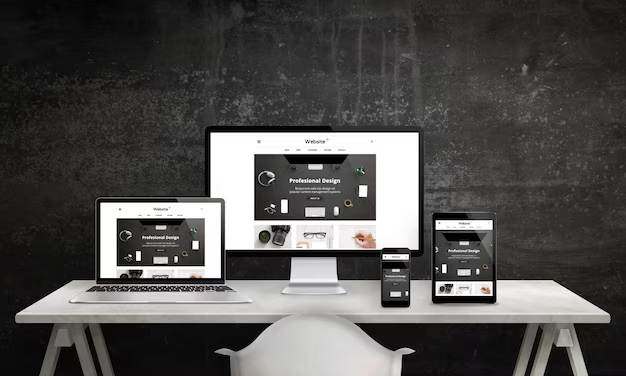
The price difference between a budget website and a professionally built one isn't about looks — it's about what the site actually does for your business. Here's the real breakdown.
Table of contents:
- Introduction
- Strategy Before a Single Pixel Is Designed
- Custom Design That Builds Credibility
- Conversion Architecture — The Science of Getting People to Act
- Performance, SEO, and Being Found in the First Place
- The Automation Layer — Where ROI Compounds
- The Real Question: What Is a Lead Worth to You?
- Conclusion
Introduction
The most common objection I hear when a small business owner finds out what a professionally built website costs is some version of: 'My nephew built our current site for $500 and it looks fine.' And sometimes it does look fine. The images load. The phone number is there. The colors more or less match the logo. But looking fine and actually working as a business asset are two completely different things — and the $2,500 gap between a budget build and a professional one is almost entirely explained by that difference.
A $500 website — whether it's a DIY Wix build, a template from a freelancer on Fiverr, or a favor from someone who knows 'a little about websites' — is optimized for one thing: existing. It occupies space on the internet. A professionally built website is optimized for something else entirely: converting visitors into leads and leads into customers. Those are not the same problem, and they don't have the same solution.
This is not a knock on people who are starting out with limited budgets. There's a time and a place for the budget build. But if your business is at a stage where your website is your primary sales tool — where people are Googling you before they call, visiting your site before they hire, and forming opinions about your professionalism based on what they see — then you need to understand exactly what the investment buys you. So let's get specific.
Strategy Before a Single Pixel Is Designed
The first thing a professionally built website has that a budget site almost never has is a strategic foundation. Before any design work begins, a real discovery process answers questions like: Who is your ideal customer and what do they need to see before they trust you enough to call? What action do you want visitors to take, and what's the clearest path to that action? What do your competitors' sites do well, and where are they leaving gaps you can exploit? What does your customer's buying journey look like, and how does your website fit into it?
Budget builds skip this entirely. The conversation is: 'What do you want on the homepage?' Not: 'What does your best customer type need to believe before they'll contact you?' The difference in output is enormous. A site built on strategic groundwork has a clear conversion hierarchy — it knows what the primary goal is, what the secondary goal is, and how every element on every page serves one of those goals. A site built without strategy has elements arranged aesthetically with no particular intention behind their placement.
For a tile installation company, for example, the strategic question isn't 'Should the gallery go on the homepage?' It's 'Do customers decide on tile contractors based on visual portfolio, or on trust and referrals?' The answer changes the entire design direction. If it's portfolio-driven, the gallery leads. If it's trust-driven, testimonials and certifications lead — and the gallery becomes supporting evidence, not the headline. Strategy determines structure. Structure determines conversion. No amount of good-looking design compensates for a site built on the wrong strategic foundation.
Custom Design That Builds Credibility
Budget websites look like budget websites. Not always because they're ugly — sometimes they're perfectly clean — but because they look like every other site built on the same template, with the same stock photos, the same font pairings, and the same layout patterns. Visitors don't consciously notice this, but they feel it. Generic design doesn't build trust. It blends into the noise.
A professionally designed site is built around your specific brand — your colors, your typography, your photography, your tone. When a potential customer lands on it, the site immediately communicates that this business is serious and professional. The design is intentional rather than default. The imagery is specific to your work rather than stock photos of strangers in hard hats. The layout reflects what your particular customers care about, not what a $49 template designer assumed the average business would want.
Credibility is not soft. It's money. A study by Stanford found that 75% of people judge a company's credibility based on their website design. For a local service business, that credibility judgment is often happening before the customer ever speaks to anyone at the company. The website is the first employee they meet. A generic template says 'we put up a site.' A custom design says 'we take our business seriously.' Those two signals produce different decisions in the people reading them.
Conversion Architecture — The Science of Getting People to Act
The technical term for how a website guides visitors toward a specific action is conversion architecture — and it's where the gap between a $500 and a $3,000 site is most pronounced. A budget site has a contact page with a form. A professionally built site has a deliberate conversion path on every page: clear primary calls to action, secondary conversion options for people who aren't ready to call, trust signals positioned at exactly the moments when doubt is highest, and friction removal at every step of the process.
Let's make this concrete. On a roofing contractor's site, a visitor lands on the homepage from a Google search for 'roof replacement Modesto.' Within three seconds they need to see: that you serve Modesto, that you do roof replacement, and what they should do next. A budget site might have all three pieces of information somewhere on the page, but they're not necessarily visible without scrolling, reading, or looking for them. A professionally built site answers all three questions above the fold — before the visitor has to work for anything — and places a clear call to action within immediate reach.
This kind of design is not accidental. It comes from understanding how people actually navigate web pages — where their eyes go first, at what scroll depth they typically disengage, which CTAs get clicked and which get ignored. A budget build doesn't have this knowledge baked into it. A professional build does. And the difference shows up directly in your conversion rate: the percentage of visitors who become leads. A site converting at 3% versus one converting at 1.5% is, depending on your traffic, the difference between 30 new leads a month and 15.
Performance, SEO, and Being Found in the First Place
A $500 website is often built fast — because time is how budget services make their economics work. Fast builds tend to produce sites with unoptimized images, bloated page builders, unnecessary plugins, and no meaningful technical SEO foundation. The site loads slowly. It scores poorly on Google's Core Web Vitals. And it ranks accordingly — meaning the people who would find you through Google often don't, because the site isn't competitive in search.
A professionally built website is engineered to perform. Images are optimized and lazy-loaded. Code is clean and minimal. The technical SEO foundation is built in from day one: proper heading hierarchy, schema markup, meta tags, sitemap, canonical tags, page speed optimization. These aren't add-ons that get bolted on after launch. They're built into the architecture. The result is a site that Google can crawl, understand, and rank — which is the precondition for any organic traffic at all.
Local SEO in particular requires technical precision. Your Google Business Profile needs to be consistent with your website's NAP data. Your service pages need to target the right geographic keywords with enough content depth to rank. Your site needs to load fast on mobile — because most local searches happen on phones. None of this is handled by a budget build. All of it is standard practice on a professionally built site. The organic traffic you earn from this foundation has no ongoing cost. It's the closest thing to free leads that exists.
The Automation Layer — Where ROI Compounds
This is the one that most clearly separates a $3,000 website from a $500 one — because it's the one that most people don't know to ask about. A budget site collects a form submission and sends it to your inbox. A professionally built site — at least at the level we build at Ascend Pro — connects the website to an automation layer that handles what happens after the form is submitted. The immediate text response. The follow-up email sequence. The appointment reminder. The review request after the job is done.
These automations turn the website from a passive display into an active business system. The site is no longer just where people go to learn about you — it's the entry point into a process that runs independently, consistently, and without anyone on your staff having to manage it. That's a fundamentally different kind of business asset. The ROI doesn't stop at the visit or even at the conversion. It continues through the customer lifecycle: re-engagement, repeat business, referral requests.
The compounding effect of this is significant over time. A business that captures every lead, follows up automatically, books more appointments, gets more reviews, and re-engages past clients systematically will outperform an equivalent business without these systems — not because they're smarter or better at their craft, but because their systems are better. Over 12 months, the revenue difference between a site that works and one that just exists can easily exceed the cost of the site itself many times over.
The Real Question: What Is a Lead Worth to You?
Here's the frame that makes the math simple. If your average job is worth $1,500, and a professionally built website converts at 3% versus a budget site's 1.5%, the difference is 15 leads per month per 1,000 visitors. At a 40% close rate, that's six additional jobs per month. At $1,500 per job, that's $9,000 in additional monthly revenue — from the same traffic, to a better website. The site pays for itself in the first month and then continues generating that margin indefinitely.
Obviously the numbers vary by business, traffic volume, and close rate. But the underlying math holds across service industries. The question is never really 'Can I afford a $3,000 website?' The question is 'What is my conversion rate costing me right now?' A budget site that converts at half the rate of a professionally built one is not saving you $2,500. It's costing you many multiples of that every single month in leads that arrived and left unconverted.
I tell every potential client the same thing: if your business is generating more than $5,000 a month in revenue, your website should be the best investment you make this year. Not because of how it looks — because of what it does. Strategy, custom design, conversion architecture, technical performance, and automation: those are not luxury upgrades. They're the difference between a website that earns you money and one that occupies space on the internet.
Conclusion
A $500 website is not a bad value for what it is: a digital presence that confirms your business exists. If you're brand new, pre-revenue, or in a business where the website is a reference point rather than a sales tool, it's a perfectly reasonable place to start. But if your website is supposed to be generating leads — if it's the thing people check before they decide whether to call you — then 'existing' is not enough.
A $3,000 website earns its cost through strategy, design, performance, and automation. It is built to convert visitors into leads and leads into customers, consistently, at all hours, without depending on someone remembering to follow up. It's not a prettier version of a budget site. It's a different tool, built for a different job.
The businesses in your market that are growing are not doing it with better services alone. They're doing it with better systems. Their website works while they sleep. Their follow-up never misses. Their reviews accumulate automatically. That's what a professionally built website actually does — and that's what the investment is really paying for.

Let's talk about your project!